Prevent Duplicate Form Submissions: 4 Fixes That Actually Work
Stop double clicks, refreshes and retries from sending the same form twice. Disabled buttons, Post/Redirect/Get, request locks and idempotency keys, with code.
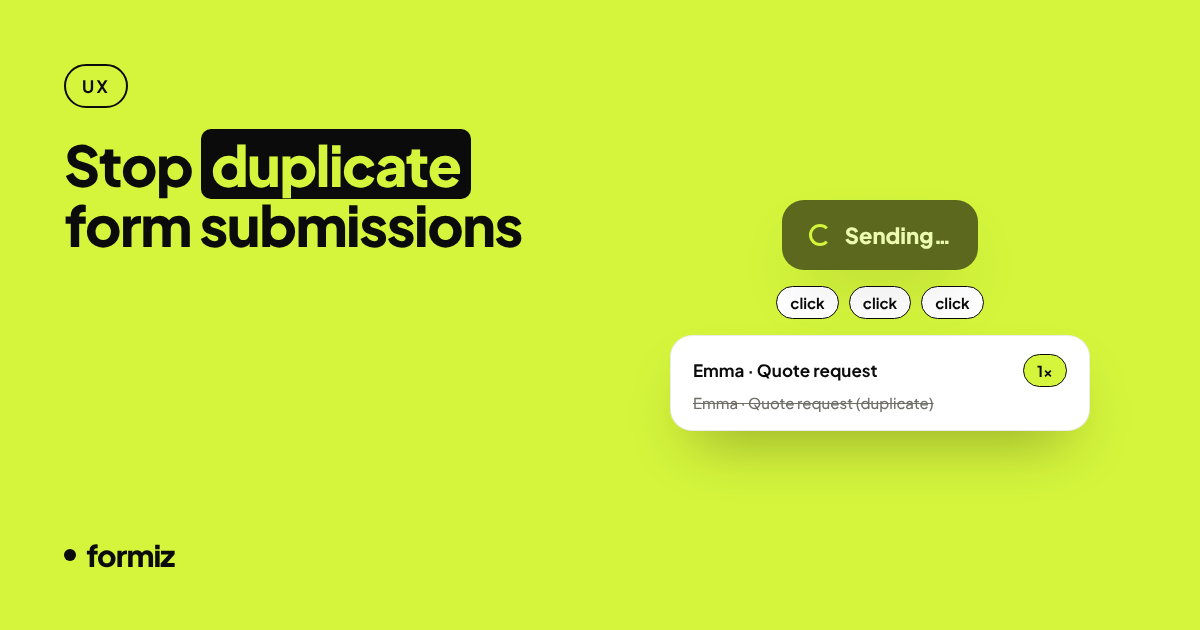
You get the same enquiry twice, sometimes three times, a few seconds apart. It is not spam; it is a real person who double-clicked, hit refresh or pressed Send again because nothing seemed to happen. Duplicates are annoying in your inbox and worse in your follow-up: two teammates may reply to the same lead.
Here is why they happen and how to stop them.
Why duplicates happen
| Cause | What the visitor did |
|---|---|
| Double click | Clicked the button twice quickly |
| No feedback | Waited, saw nothing, clicked again |
| Slow network | Request still in flight, pressed again |
| Refresh after POST | Browser re-sent the form ("Confirm form resubmission") |
| Back button | Returned to the form and submitted again |
| Automatic retries | A script retried after a timeout, but the first request had succeeded |
Fix 1: Disable the button while sending
The single most effective fix. Disable the submit button the moment the request starts and show that something is happening:
form.addEventListener('submit', async (e) => {
  e.preventDefault();
  const btn = form.querySelector('[type="submit"]');
  if (btn.disabled) return;           // already sending
  btn.disabled = true;
  btn.textContent = 'Sending…';
  try {
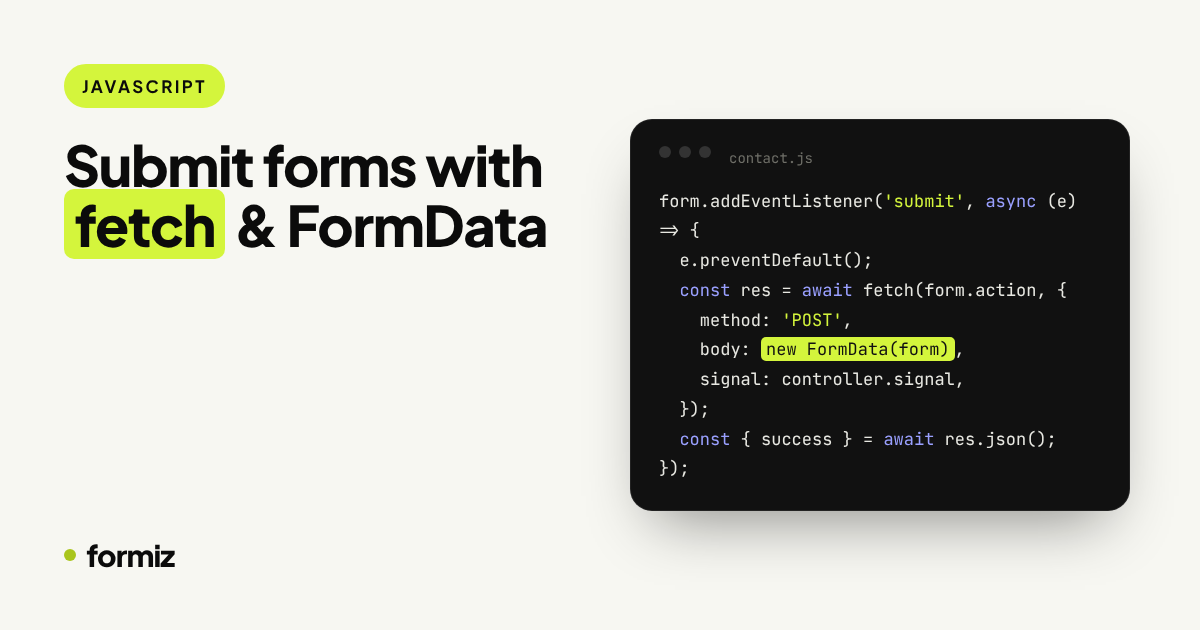
    const res = await fetch(form.action, { method: 'POST', body: new FormData(form) });
    const data = await res.json();
    if (!data.success) throw new Error(data.message);
    form.replaceWith(Object.assign(document.createElement('p'), { textContent: 'Thanks! Message sent.' }));
  } catch (err) {
    btn.disabled = false;             // allow a retry only on failure
    btn.textContent = 'Send';
    alert(err.message || 'Something went wrong.');
  }
});
Replacing the form with the success message (instead of only resetting it) also removes the temptation to submit again.
Fix 2: Post/Redirect/Get for non-JavaScript forms
If a plain HTML form posts and the server responds with a page directly, refreshing that page re-sends the POST. The fix is Post/Redirect/Get: after a POST, redirect to a normal GET page (a thank-you page). Refreshing the thank-you page is harmless.
Formiz does this for you. A standard form post gets a 303 See Other redirect to a thank-you page (or your own redirect URL), so refresh and back-button resubmissions do not happen.
Fix 3: Give immediate feedback
Many duplicates come from uncertainty, not impatience. Show "Sending…" instantly, and on success show a message that clearly says it worked and what happens next. See thank-you pages and inline messages.
Fix 4: Do not retry blindly
If you add automatic retries for flaky networks, only retry when you are sure the first request failed (no response at all), and never after a timeout without a way to deduplicate. Otherwise a slow-but-successful request plus a retry equals two submissions.
Fix 5: Idempotency keys (for your own backend)
If you run your own endpoint, generate a unique ID when the form loads and send it with the submission:
<input type="hidden" name="submission_id" id="submission_id">
<script>document.getElementById('submission_id').value = crypto.randomUUID();</script>
On the server, store processed IDs and ignore repeats. This is the robust solution for payments and orders; for contact forms, fixes 1–3 are usually enough.
Fix 6: Rate limiting as a safety net
A burst of identical submissions from one source is also a classic bot pattern. Formiz rate-limits repeated submissions from the same visitor within a short window, which catches runaway scripts and frantic clicking alike.
Checklist
- Submit button disabled while sending
- "Sending…" feedback within 100 ms
- Form replaced by a clear success message
- Non-JS posts use Post/Redirect/Get
- No blind retries after timeouts
- Rate limiting on the receiving end
Related: submit a form with fetch and FormData.
Get your form working in five minutes
Create a free Formiz key, add it to your form and receive submissions by email and Telegram. No server, no SMTP, no card.